
Draft 2025
"This is an incredible day for the Packers, Greater Green Bay and the entire state of Wisconsin as we are excited and honored to be selected to host the 2025 NFL Draft." - Mark Murphy, Former President/CEO, May 22, 2023
The 2025 NFL Draft took place in Green Bay inside and around iconic Lambeau Field and the Titletown District. The NFL's most prominent and anticipated offseason event included activities throughout Green Bay and featured the NFL Draft Experience - a massive free football festival - near Lambeau Field and allowed fans of all teams to participate and test their football skills, enjoy interactive exhibits and autograph sessions, and take pictures with the Vince Lombardi Trophy.
The NFL Draft Returns
The NFL Draft returns to Wisconsin after 85 years, when Milwaukee was the site of the 1940 draft, held on Dec. 9, 1939. Milwaukee was the site of the draft because it was also the host city of the NFL Championship Game played the next day. Curly Lambeau and the Packers' executive committee had decided, at the urging of the NFL, that more money could be made if the game was played at State Fair Park in nearby West Allis rather than at Green Bay's City Stadium.
The 1940 draft was held in the glitzy but smoke-filled Empire Ballroom of the Schroeder Hotel on Wisconsin Avenue - now the Hilton City Center - and the VIP list of league titans included George Halas, owner and coach of the Chicago Bears; Art Rooney, owner, and Walt Kiesling, coach, of the Pittsburgh Steelers; Bert Bell, owner and coach of the Philadelphia Eagles, as well as future NFL commissioner.
"We'd sit in that damn room, and everybody was suckin' on cigarettes. You'd get antsy. You were liable to draw anybody. I call that the Stone Age." - Lee Joannes, Packers President 1930-47
While football people at least might have stayed focused on the task at hand, team owners tended to roam the room making idle conversation.
"I think I used to visit every table in the place while they were drafting. They were happy to see some new face. And they knew I didn't pay attention to the draft. And I wasn't the only one. Everybody would get up and walk around and talk." - Art Rooney, Pittsburgh Steelers
While there were 20 rounds, there were only 10 NFL teams at the time and so the 1940 draft moved along faster than it would over the marathon sessions of the near future.
In fact, seven hours after the draft started, the participants, as well as some of the sportswriters who had covered it, gathered at the nearby Schlitz Brown Bottle for beers and snacks. In between, they had feasted on tenderloin steak at dinner hosted by the Packers.
As for onlookers, the only two might have been Joe Sullivan, a Milwaukee native and future NFL assistant coach and executive, and his older brother, Jack, who was already laying the groundwork for what has since become a cottage industry. There's no way of proving it, but he and Joe might have been the original draftniks. At the time of that draft, Joe was a 15-year old high school freshman living in Milwaukee.
Given their budding interest in the draft, the Sullivans went down to the Schroeder the night before.
"We thought we might be able to talk somebody into getting us in on Saturday. All of them stayed at the hotel. We were too young to go to the bar, but we'd catch them when they'd come out. We were like the mingle-type people. But there weren't many others around. There weren't many people interested in it. And there was no publicity about it." - Joe Sullivan
Rebuffed in their efforts, the Sullivans stayed away the next day but arranged to pick up a list of the picks that evening at the old Milwaukee Sentinel building, located at 123 W. Michigan Ave. They also had gotten a sneak peek of the draft room the night before.
"I'd seen the room. They only used part of it. It was on the mezzanine above the lobby. There was a bandstand and that's where the league office people were. And there was a dance floor and that's where the tables were set up for each of the teams." - Joe Sullivan
Included in that room was a large board with the names of the top college players eligible for the draft. As he did for other early drafts, Wellington Mara, then 23 years old, compiled the list.
"Your preparation for the draft in those days consisted mainly of people you knew or your coach knew or who formerly played with you and were in college football, and what you could get out of a few football magazines." - Wellington Mara
His board was designed to assist the teams that didn't invest much time or money in the draft, but the clubs also were free to pick players not on his board.
"I was interested. I used to spend all my spare time reading magazines and getting out-of-town papers, and so on. And I guess nobody else was willing to make up the list. The reason was I was the youngest one around and the wished it off on me." - Wellington Mara
The assignment lasted only a few years for Mara, before sharing the information was deemed necessary for competitors like Halas and Lambeau. With the first choice in the 1940 draft, the Chicago Cardinals selected Tennessee back George Cafego. The Packers selected ninth and too Minnesota back Hal Van Every.
.jpeg?sfvrsn=2763e898_0 "2024_07_03 JKaempfer (6)")
.jpeg?sfvrsn=b4ac7ed2_0 "2024_07_03 JKaempfer (23)")
Hall of Fame Architect
Ron Wolf was the architect of the remarkable and unlikely resurgence of the Green Bay Packers in the 1990s following a 24-year famine by the franchise. He turned what had been one of the most hapless teams in the NFL into one of the most successful. Wolf was considered one of the best in the business at finding talent in the mid to late rounds of the NFL draft. In all, he selected eight players in rounds five through seven who were selected to a Pro Bowl. Wolf was inducted into the Pro Football Hall of Fame in 2015. He is one of only six general managers ever to be inducted into Canton.
Timeline of the NFL Draft
.jpeg?sfvrsn=a8753eac_0 "2024_07_03 JKaempfer (3)")
.jpeg?sfvrsn=6936675c_0 "2024_07_03 JKaempfer (4)")
Draft Grading System
Birth of the Combine
The first draft combine was Troika in the early 1960s. It was the brainchild of the Cowboys' general manager Tex Schramm and Los Angeles Rams owner Dan Reeves. Schramm had been Reeves' general manager before taking over the Cowboys in 1960. Troika was a clandestine operation between three teams: the Cowboys, Rams and San Francisco 49ers. The teams secretly shared scouting reports. This led to the formation of the national scouting program.
BLESTO v NFS
There are two major league-wide scouting programs all teams collect data from today - BLESTO and NFS. The name "BLESTO" originates from the teams who comprised the organization in the early years: Bears-Lions-Steelers-Talent-Organization. There are more teams than that today, 12 in all. The Lions, Eagles and Steelers started the partnership in 1963 (the called LESTO). It became BLESTO when the Chicago Bears joined shortly after. BLESTO excelled under the leadership of Jack Butler, former Pro Football Hall of Fame defensive back with the Pittsburgh Steelers. He was a scout in the first year, and he became director in 1964.
The other league-wide scouting organization is NFS - National Football Scouting. Most of the rest of the league is part of NFS, which was originally formed by the Baltimore Colts, the Cleveland Browns, the Green Bay Packers and the St. Louis Cardinals. It was organized in 1964 and then called CEPO (Central Eastern Personnel Organization). NFS would eventually emerge from that organization. Vince Lombardi was heavily involved in founding it and hired former Packers head coach Lisle Blackbourn to be one of the six original scouts.
Today, teams tailor the scouting information to their organization. For example, the Packers currently simplify whether they view a prospect as a starter or backup rather than assigning a specific draft round grade.
Letter Grading System
The numerical system was preceded in the NFL by a letter-grading system. It provided a physical description to the people who understood the system and what the prototypical values were that the team thought were important.
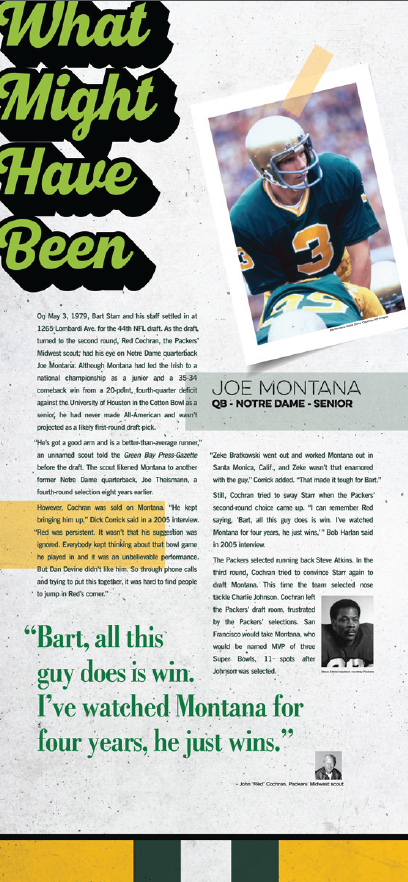
What Might Have been
On May 3, 1979, Bart Starr and his staff settled in at 1265 Lombardi Ave. for the 44th NFL draft. As the draft turned to the second round, Red Cochran, the Packers' Midwest scout, had his eye on Notre Dame quarterback Joe Montana. Although Montana had let the Irish to a national championship as a junior and a 35-34 comeback win from a 20-point, fourth-quarter deficit against the University of Houston in the Cotton Bowl as a senior, he had never made All-American and wasn't projected as a likely first-round draft pick.
"He's got a good arm and is a better-than-average runner," an unnamed scout told the Green Bay Press-Gazette before the draft. The scout likened Montana to another former Notre Dame quarterback, Joe Theismann, a fourth-round selection eight years earlier.
However, Cochran was sold on Montana. "He kept bringing him up," Dick Corrick said in a 2005 interview. "Red was persistent. It wasn't that his suggestion was ignored. Everybody kept thinking about that bowl game he played and it was an unbelievable performance. But Dan Devine didn't like him. So through phone calls and trying to put this together, it was hard to find people to jump in Red's corner.
"Zeke Bratkowski went out and worked Montana out in Santa Monica, Calif., and Zeke wasn't that enamored with the guy," Corrick added. "That made it tough for Bart."
Still, Cochran tried to sway Starr when the Packers' second-round choice came up. "I can remember Red saying, 'Bart, all this guy does is win. I've watched Montana for four years, he just wins,'" Bob Harlan said in a 2005 interview.
The Packers selected running back Steve Atkins. In the third round, Cochran tried to convince Starr again to draft Montana. This time the team selected nose tackle Charlie Johnson. Cochran left the Packers' draft room, frustrated by the Packers' selections. San Francisco would take Montana, who would be named MVP of three Super Bowls, 11 spots after Johnson was selected.